The pipeline operator : the same composition, but read left to right, the way the data flows. It is defined for any instance of :
(>>>) :: Category cat => cat a b -> cat b c -> cat a c
f >>> g = g . f

-- arrows of the Hask category:
clean :: String -> String
clean = trim >>> lowercase >>> collapseSpaces

-- arrows of the Kleisli category:
pipeline :: Kleisli Maybe String User
pipeline = Kleisli parse >>> Kleisli validate >>> Kleisli build
So far our pipeline is a single pipe: joins the stages strictly one after another. But since we have taken to steering the flow of data, why not run the goods through the pipes at full throttle: feed a pair in and process its halves separately. This is what the type class is for:
class Category a => Arrow a where
  arr    :: (b -> c) -> a b c
  first  :: a b c -> a (b, d) (c, d)
  second :: a b c -> a (d, b) (d, c)
  (***)  :: a b c -> a b' c' -> a (b, b') (c, c')
  (&&&)  :: a b c -> a b c'  -> a b (c, c')
There is no getting by without explanations here: lifts a pure function into the pipeline; runs the first component of a pair through the arrow while carrying the second past it, untouched, along a bypass channel — this is the “data past a stage”; is the mirror twin of : it processes the second component while the first rides by; runs two arrows over the two halves of a pair in parallel; forks the flow: a single input is duplicated into both arrows, and the output is the pair of results. In fact, two class methods are enough: , and are all derived from and .
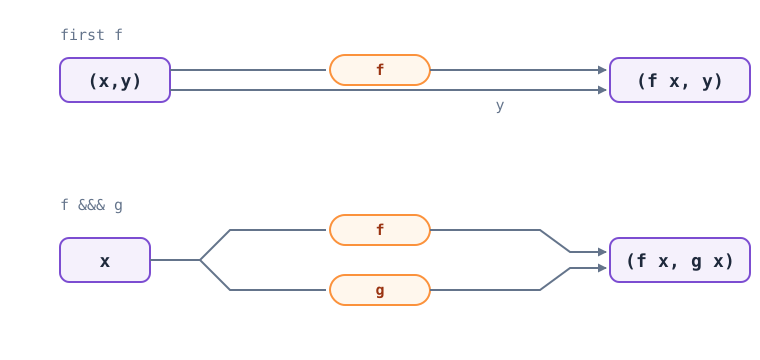
Now a couple of instances — the plain function and the Kleisli arrow:
-- substitute a := (->) into the signature of first:
first :: a    b c -> a    (b, d) (c, d)
first :: (->) b c -> (->) (b, d) (c, d)   -- a := (->)
first :: (b -> c) -> ((b, d) -> (c, d))   -- prefix (->) x y is infix x -> y

instance Arrow (->) where
  arr f          = f
  first f (x, y) = (f x, y)

-- the same for a Kleisli arrow, a := Kleisli m:
first :: a         b c -> a         (b, d) (c, d)
first :: Kleisli m b c -> Kleisli m (b, d) (c, d)   -- a := Kleisli m
first :: (b -> m c)    -> ((b, d) -> m (c, d))      -- with the newtype wrapper removed

instance Monad m => Arrow (Kleisli m) where
  arr f              = Kleisli (pure . f)
  first (Kleisli f)  = Kleisli (\(x, y) -> do c <- f x; pure (c, y))
A practical example — a summary of response times: the mean and the maximum in one pipeline. Fig. 2.10 shows how it flows — note that appears twice: not only on the outside but also inside ():
mean :: [Double] -> Double
mean = (sum &&& genericLength) >>> uncurry (/)

summary :: [Double] -> (Double, Double)
summary = mean &&& maximum

summary [12, 8, 40] -- (20.0, 40.0)![The summary pipeline: the outer &&& forks [12,8,40] into two branches; inside, sum and genericLength give 60 and 3, uncurry (/) divides them into 20.0, maximum gives 40.0, the result is the pair (20.0, 40.0)](/book/images/hs-summary.svg)
Pure functions are not the whole story: the combinators work for any arrow. Let us move the pipeline into the Kleisli category: the response times no longer sit in a ready-made list but are read from a file — the pipeline now lives in IO. The first step is a genuine Kleisli arrow, then lifts the pure and into the same category, and the fork repeats the line word for word:
-- the same summary, but the response times now come from a file
readTimes :: Kleisli IO FilePath [Double]
readTimes = Kleisli readFile >>> arr (lines >>> map read)

summaryIO :: Kleisli IO FilePath (Double, Double)
summaryIO = readTimes >>> arr mean &&& arr maximum   -- cf.: summary = mean &&& maximum

runKleisli summaryIO "times.log"   -- a file with lines 12, 8, 40 -> (20.0, 40.0)
Now a few words not about the pair but about ; working with it is moved out into a separate class, :
class Arrow a => ArrowChoice a where
  left  :: a b c -> a (Either b d) (Either c d)
  right :: a b c -> a (Either d b) (Either d c)
  (+++) :: a b c -> a b' c' -> a (Either b b') (Either c c')
  (|||) :: a b d -> a c d   -> a (Either b c) d
Each method is a twin of an Arrow method: and mirror and , only they process one branch of an instead of one half of a pair, letting the other branch pass through untouched; if processes both halves of a pair, its twin processes only the branch that actually arrived, while — the twin of — additionally merges the two branches into a common output, routing the flow. The instance for the plain function arrow :
-- substitute a := (->) into the signature of left:
left :: a    b c -> a    (Either b d) (Either c d)
left :: (->) b c -> (->) (Either b d) (Either c d)   -- a := (->)
left :: (b -> c) -> (Either b d -> Either c d)

instance ArrowChoice (->) where
  left f (Left  x) = Left (f x)   -- the left branch arrived — process it
  left f (Right y) = Right y      -- the right one passes through untouched

-- the remaining methods are derived from left:
f +++ g = left f >>> right g
f ||| g = (f +++ g) >>> arr (either id id)
A practical example — the same summary, now guarded against an empty log: sends each branch down its own pipeline, and merges them into a common output:
checkLog :: [Double] -> Either String [Double]
checkLog xs = if null xs then Left "empty log" else Right xs

report :: [Double] -> String
report = checkLog >>> (("no summary: " ++) +++ summary) >>> (id ||| show)

report [12, 8, 40]   -- "(20.0,40.0)"
report []            -- "no summary: empty log"