Every abstraction of this part (monoid, functor, monad) is expressed in Haskell by a single mechanism — the type class: an overloadable interface plus laws that implementations must obey. A class with laws is an algebraic structure, not merely an interface as in, say, TypeScript.
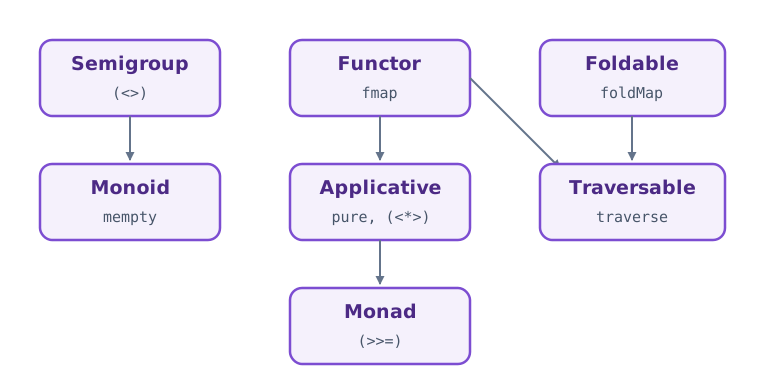
As an example, consider the Functor type class: the class declaration defines the interface — the signature of the single method — and an instance declaration implements this interface for a concrete type, here for .
class Functor f where
  -- fmap applies an ordinary function inside the context f
  fmap :: (a -> b) -> f a -> f b
instance Functor Maybe where
-- if there is a value, apply the function to it
fmap g (Just x) = Just (g x)
-- if there is none, the Nothing context is preserved
fmap g Nothing = NothingA method call is dispatched by type: the compiler sees that is applied to a value of type and picks the instance above. Moreover, a type class can dispatch on the return type as well: for example, — the neutral element from the Monoid class — takes no arguments at all and “learns” its type from the call site. Class laws are not checked by the compiler — they are a contract on the conscience of the instance author: a class can be instantiated incorrectly — say, with an that loses elements of the container — the compiler will accept such an instance, but code that relies on the laws will start producing wrong results. One more rule: a type gets at most one instance of a class (coherence).
Now, kinds: a kind tells how many parameters a constructor still lacks to become an ordinary type with values.
Int :: *
-- Int is an ordinary type: it has values

Maybe :: * -> *
-- Maybe is a type constructor with one parameter

Either :: * -> * -> *
-- Either is a type constructor with two parameters
The kind (a.k.a. ) is the kind of ordinary types, the ones that have values. is not a type but a type constructor: a function at the type level that takes a type (say, ) and returns a type (). Classes differ in the kind of their parameter: — equality comparison — wants an ordinary type , while wants a constructor : a container can be a functor, a value cannot. Partial application works at the type level too: has kind , but is already a legitimate functor.